Car Rental Application
A production-grade microservices platform for renting cars with real-time availability, booking management, and geo-spatial search
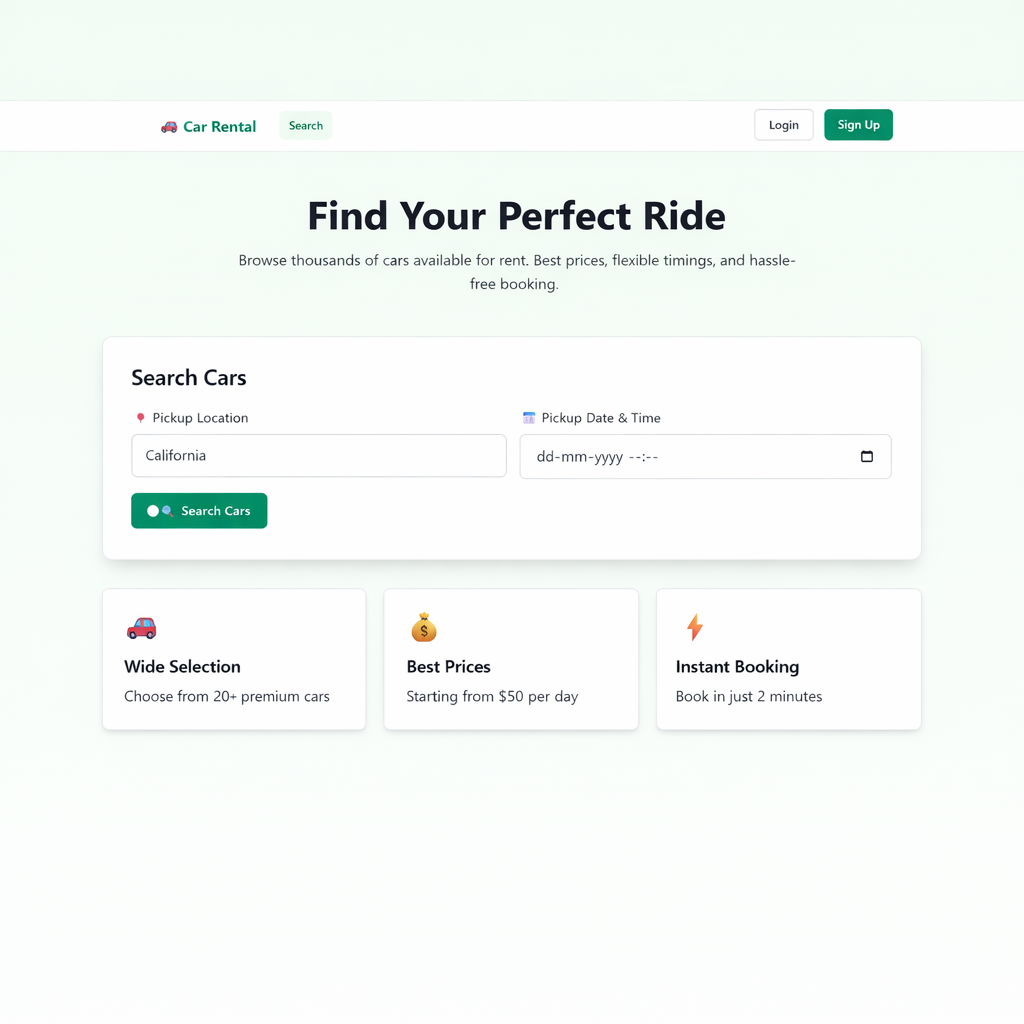
A full-stack car rental application demonstrating modern microservices architecture and production-ready frontend development. The backend features multiple specialized services (Auth, Car, Search, Booking, Notification) built with TypeScript, Fastify, and Prisma, while the frontend is a sophisticated React SPA with MSW (Mock Service Worker) for API simulation. The system handles real-time car search using Elasticsearch geo-spatial queries, atomic booking operations, JWT token refresh queuing, and optimistic UI updates.
- ✓Microservices architecture with API Gateway pattern (6 independent services)
- ✓Real-time car search with Elasticsearch geo-spatial queries
- ✓JWT authentication with refresh token rotation and queue-based refresh pattern
- ✓Atomic booking operations with transaction handling
- ✓Optimistic UI updates for faster perceived performance
- ✓MSW-based mock API for frontend development without backend dependency
- ✓Comprehensive error handling and validation (Zod schemas)
- ✓Docker containerization with docker-compose orchestration
- ✓Production-ready logging and error tracking
Technical Deep Dive
Token Refresh Race Condition - Coordinating multiple simultaneous API requests during token refresh without duplicate refresh calls
Solution
Implemented token refresh queue pattern to deduplicate simultaneous 401 errors and queue pending requests
Implementation
Token Refresh Queue Pattern
// Prevent duplicate token refresh requests
let isRefreshing = false;
let failedQueue: Array<{
  resolve: (token: string) => void;
  reject: (error: Error) => void;
}> = [];

function processQueue(error: Error | null, token: string | null) {
  failedQueue.forEach((prom) => {
    if (error) prom.reject(error);
    else prom.resolve(token!);
  });
  failedQueue = [];
}

// Axios interceptor - handle 401 response
if (error.response?.status === 401) {
  if (!isRefreshing) {
    isRefreshing = true;
    try {
      const newToken = await refreshAccessToken();
      processQueue(null, newToken);
      return instance.request(config); // Retry
    } catch (err) {
      processQueue(err as Error, null);
      redirect('/login');
    } finally {
      isRefreshing = false;
    }
  } else {
    // Queue if refresh in progress
    return new Promise((resolve, reject) => {
      failedQueue.push({ resolve, reject });
    });
  }
}Implementing efficient geo-spatial search for real-time car availability queries
Solution
Configured Elasticsearch with geo-point mapping and geo_distance queries for sub-100ms location-based search
Implementation
Elasticsearch Geo-Spatial Query
// Configure Elasticsearch geo-point mapping
const carMapping = {
  properties: {
    location: { type: 'geo_point' },
    available: { type: 'boolean' },
    pricePerDay: { type: 'float' }
  }
};

// Perform geo-distance search
async function searchNearby(lat: number, lon: number, radius: string) {
  const result = await elasticClient.search({
    index: 'cars',
    body: {
      query: {
        bool: {
          filter: [
            { term: { available: true } },
            {
              geo_distance: {
                distance: radius, // e.g., "10km"
                location: { lat, lon }
              }
            }
          ]
        }
      },
      sort: [
        {
          _geo_distance: {
            location: { lat, lon },
            order: 'asc',
            unit: 'km'
          }
        }
      ]
    }
  });
  return result.hits.hits.map(hit => hit._source);
}Handling race conditions in booking operations to prevent double-booking
Solution
Used database transactions with row-level locking and optimistic concurrency control for atomic booking operations
Implementation
Atomic Booking with Row-Level Locking
// Prevent double-booking with transactions
async function createBooking(carId: string, userId: string, dates: DateRange) {
  return await prisma.$transaction(async (tx) => {
    // Lock the car row for update
    const car = await tx.car.findUnique({
      where: { id: carId },
      select: { available: true, bookings: true }
    });

    if (!car?.available) {
      throw new Error('Car not available');
    }

    // Check for conflicting bookings
    const conflicts = car.bookings.some(b =>
      datesOverlap(b.startDate, b.endDate, dates.start, dates.end)
    );

    if (conflicts) {
      throw new Error('Car already booked for these dates');
    }

    // Atomically create booking and update car
    const [booking] = await Promise.all([
      tx.booking.create({
        data: { carId, userId, ...dates }
      }),
      tx.car.update({
        where: { id: carId },
        data: { available: false }
      })
    ]);

    return booking;
  }, {
    isolationLevel: 'Serializable',
    timeout: 5000
  });
}